Glucosinolates in Cover Crops: Understanding the Chemistry That Drives Soil Function
The brassica plants in your field carry a chemical arsenal. Most farmers don’t know which weapon they’re deploying – or why it matters enormously for root health and soil biology.
Farmers treating glucosinolates as a single thing is the same mistake as treating all pesticides as interchangeable. There are over 120 distinct glucosinolate compounds, each with a different biological target, breakdown product, and effect on your soil. Lumping them together leads to wrong planting decisions.
The current conversation around brassica cover crops focuses almost entirely on the species – radish, mustard, turnip – without asking which specific compounds those plants produce, what part of the plant they are present, and at what concentrations.
Compound identity, not just plant species, determines whether your cover crop suppresses a pest, feeds a
beneficial microbe, or – in the wrong context – damages your following cash crop’s establishment.
The good news: once you understand the three compound families and specific compound tied to the root biomass, you can make planting decisions that actively replace fungicide and nematicide applications.
“The species tell you the tool. The glucosinolate compound tells you what that tool actually does.”
The Three Glucosinolate Families
All glucosinolates share the same core chemical structure – a glucose molecule attached to a sulfur-containing group. What makes each compound unique is the side chain attached to that core. Those side chains fall into three families, each with distinct biological activity.
FAMILY | EXAMPLE COMPOUNDS | KEY PLANT SOURCES | PRIMARY PEST TARGET |
Aliphatic | Glucoraphanin, Sinigrin, Gluconapin | Broccoli, Mustard, Canola/Rapeseed | Fungal pathogens, some insects |
Indole | Glucobrassicin, Neoglucobrassicin | Cabbage, Kale, Brussels Sprouts | Insect feeding deterrent, herbivory defense |
Aromatic | Gluconasturtiin, Glucotropaeolin | Watercress, Nasturtium, Turnip | Root-zone nematodes, soil-borne pathogens |
| KEY DISTINCTION |
| The active defense chemical isn’t the glucosinolate itself — it’s the breakdown product. When plant tissue is damaged (by tillage, freeze-kill, or pest chewing), an enzyme called myrosinase splits the glucosinolate into isothiocyanates (ITCs), nitriles, or thiocyanates. The ITC produced by gluconasturtiin — phenethyl isothiocyanate (PEITC) — is one of the most potent soil biofumigants identified in agricultural research. |
Not all brassica cover crops deliver the same effect. Each glucosinolate family produces a different breakdown product with a different mode of action.
Aliphatic ITCs target fungal cell walls and disrupt spore germination. Sinigrin from mustard releases allyl-ITC, documented to suppress Rhizoctonia and Verticillium when incorporated at high biomass rates.
Indole ITCs are less volatile with shorter soil persistence. Their primary role is above-ground insect deterrence – they interfere with feeding behavior and larval development in caterpillar species.
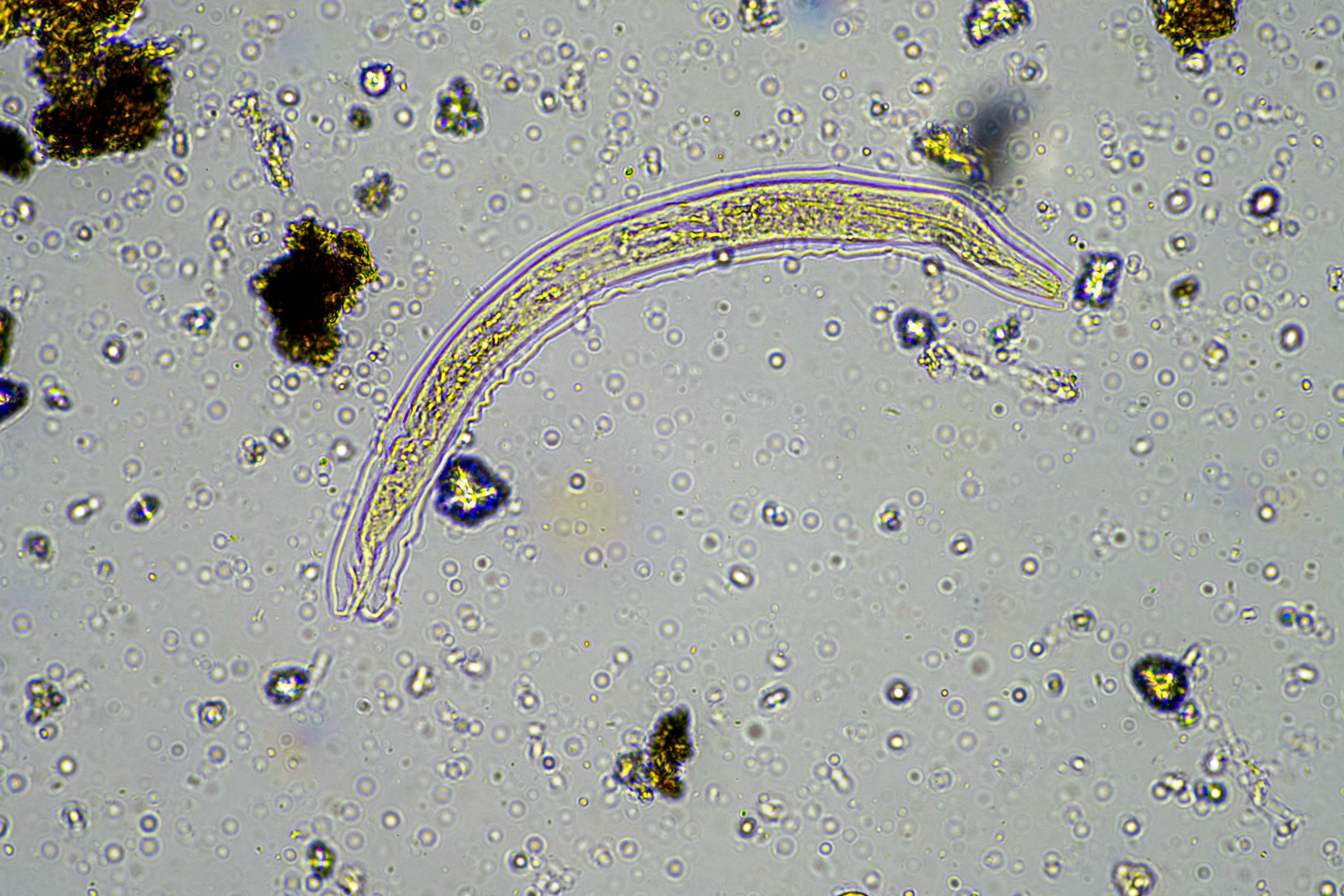
Aromatic ITCs are highly volatile with deep soil penetrations. PEITC (phenethyl isothiocyanate) is a naturally occurring ITC derived from the glucosinolate gluconasturtiin. This PEITC moves through soil pore space, reaching root-zone nematodes and Pythium species at depths other ITCs do not. Some turnips and rapes accumulate gluconasturtiin as the dominant compound in their roots, making them the most relevant field crops for delivering this ITC into the soil profile.
University of California research found that incorporating high-gluconasturtiin brassica biomass reduced Pythium ultimum populations by 67% compared to untreated controls in fumigation trials. The mechanism is direct toxicity from PEITC gas diffusing through the soil profile – not allelopathy.
Gluconasturtiin: The Root Compound Farmers Underestimate
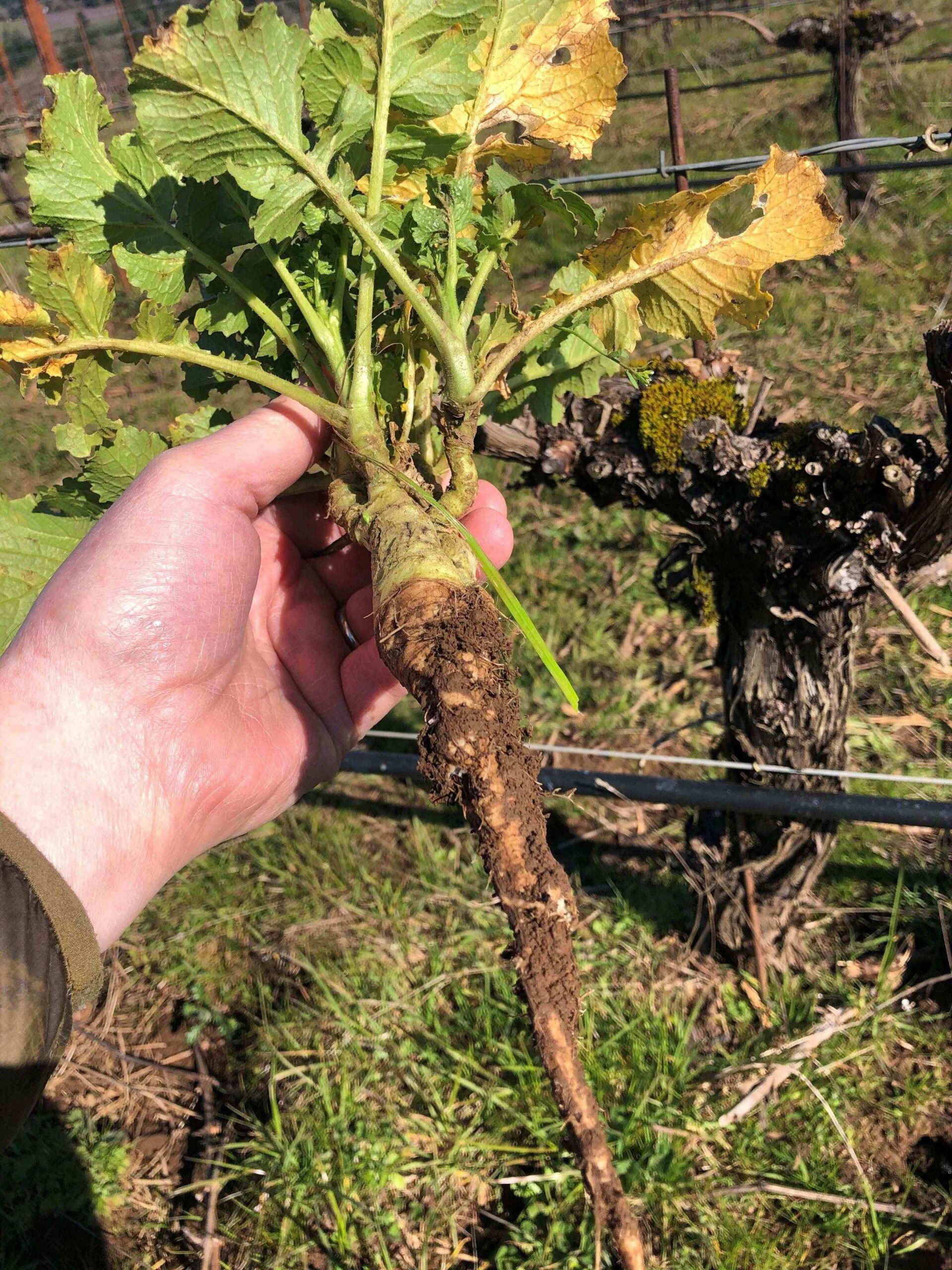
Gluconasturtiin is the dominant glucosinolate in the aromatic family and is found at high levels in the roots of some turnips and rapes (Brassica rapa and Brassica napus), as well as in watercress (Nasturtium officinale) and garden nasturtium (Tropaeolum majus). Unlike aliphatic glucosinolates that concentrate in leaf tissue, glusonasturtiin loads heavily into root tissue- exactly where soil-borne pest pressure occurs.
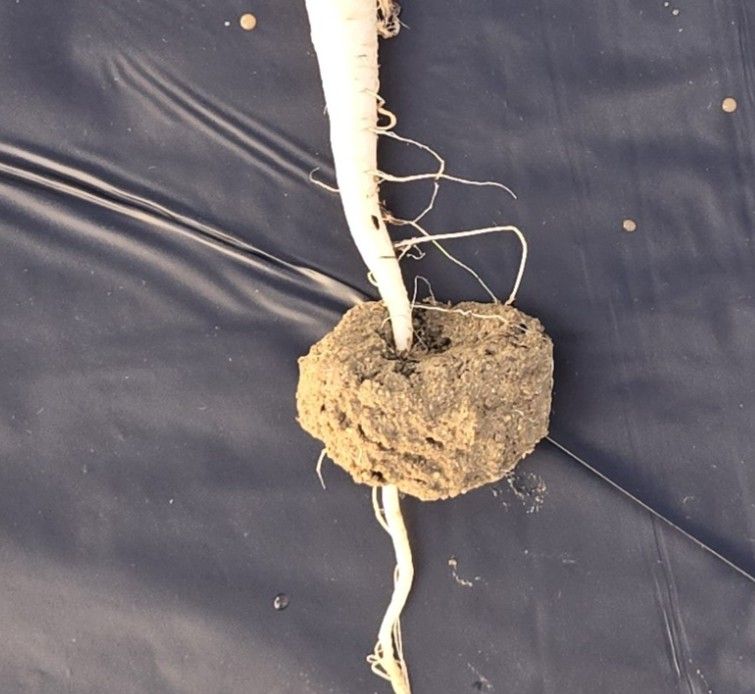
In some turnips and rapes grown as cover crops, roots accumulate gluconasturtiin as the dominant compound. This means the root mass isn’t just storing carbon – it is depositing a concentrated aromatic biofumigant payload directly into the subsoil when it decomposes or is incorporated.
The breakdown mechanism:
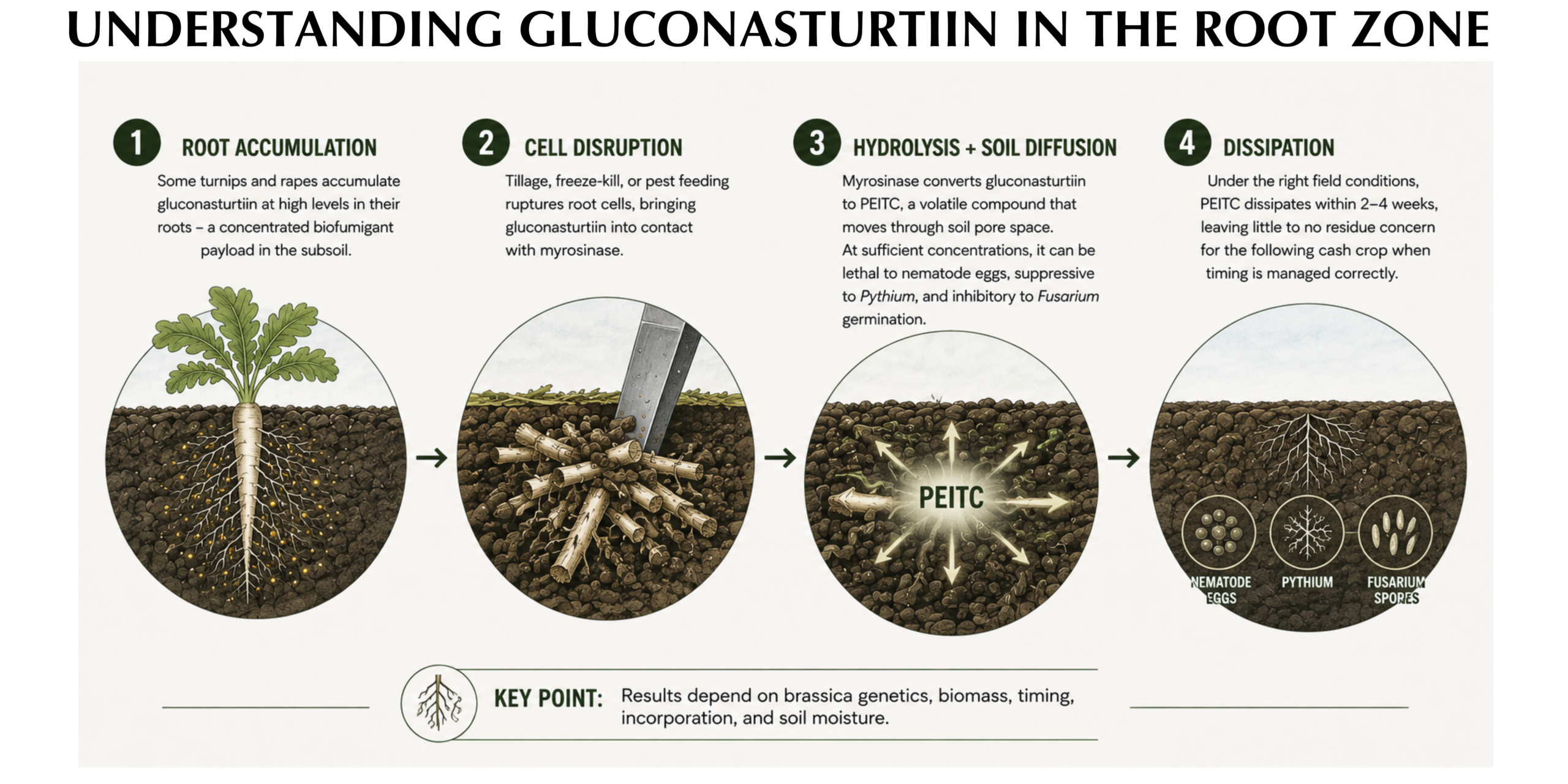
- Step 1 – Cell disruption: Tillage, freeze-kill, or pest feeding ruptures root cells, bringing gluconasturtiin into contact with the enzyme myrosinase.
- Step 2 – Hydrolysis: Myrosinase cleaves the glucose-sulfur bond, releasing PEITC as volatile gas.
- Step 3 – Soil diffusion: PEITC moves through soil pore space. At concentrations achieved from high-biomass roots, it is lethal to nematode eggs, suppressive to Pythium, and inhibitory to Fusarium germination.
- Step 4 – Dissipation: PEITC degrades within 2-4 weeks under filed conditions, leaving no residue concerns for the following cash crop if incorporation timing is managed correctly.
CRITICAL CONSIDERATION – HIGH ROOT CONCENTRATIONS
High gluconasturtiin levels in roots create a double-edged situation. When some turnips and rapes with large root mass decompose in wet, cool soils without proper incorporation, PEITC can accumulate in the soil solution at phytotoxic concentrations – suppressing germination of small-seeded cash crops planted too soon after termination.
The practical rule: allow a minimum 3-4 week window between brassica termination or incorporation and planting of small-seeded crops (carrots, small grains, brassica vegetables). Corn and soybean are more tolerant and can follow within 2-3 weeks. Soil temperature above 50F accelerates PEITC breakdown and reduces risk.
Documented Field Evidence
A multi-year study in Oregon vegetable production rotations found that fields with high-glucosinolate brassica cover crops preceding fall vegetables had 41% lower Pratylenchus penetrans (root lesion nematode) counts compared to cereal rye control plots.
Tissue analysis in trials using gluconasturtiin-dominant brassica roots confirmed PEITC as the primary active ITC – at concentrations well above the threshold associated with biofumigation efficacy in controlled studies.
Which Plants Carry Which Compounds
Not all brassica cover crops deliver meaningful biofumigation. Compound concentration varies dramatically by species and by growing conditions. Below is a practical breakdown of the most agronomically relevant species, the glucosinolate they emphasize, and where in the plant that compound is stored.
PLANT | DOMINANT GLUCOSINOLATE | FAMILY | PRIMARY STORAGE TISSUE | KEY ITC RELEASED |
Daikon Radish | Glucoraphasatin | Aliphatic | Root (taproot) | 4-MTBITC (Raphasatin) |
Brown/Oriental Mustard | Sinigrin | Aliphatic | Seeds & stems | Allyl ITC |
Canola/Rapeseed | Gluconapin | Aliphatic | Seeds | But-3-enyl ITC |
Kale / Cabbage | Glucobrassicin | Indole | Leaves | Indole-3-carbinol |
Watercress | Gluconasturtiin | Aromatic | Leaves & stems | PEITC |
Garden Nasturtium | Glucotropaeolin | Aromatic | Leaves | Benzyl ITC |
Some Turnips & Rapes | Gluconasturtiin | Aromatic | Root | PEITC |
Practical Takeaway
Root-zone nematodes or Pythium? Some turnips and rapes – gluconasturtiin in their roots is your active ingredient, releasing PEITC into the subsoil. Above-ground leaf-chewing insects? Kale or cabbage interplanted as a trap crop leverages indole glucosinolates. Soil-borne fungi broadly? Mustard with high sinigrin content, incorporated at high biomass, is the established tool.
How Glucosinolates Reduce Reliance on Chemical Inputs
Biofumigation with high-glucosinolate cover crops is not a fringe concept – it is a mechanism with a peer-reviewed mode of action and documented field results across multiple cropping systems. The key is matching the right compound to the target pest.
- Nematodes: PEITC from gluconastrutiin disrupts nematode neuromuscular function. Root lesion nematode (Pratylenchus) and root knot nematode (Meloidogyne) egg hatching is suppressed at PEITC concentrations achievable from 3-5 tons/acre of fresh brassica biomass (some turnips and rapes) incorporated at peak root mass.
- Soilborne fungal pathogens: Allyl-ITC from sinigrin (mustard) and PEITC both disrupt ergosterol synthesis in fungal cell membranes – the same target as many synthetic fungicides. Washington State University trials showed sinigrin-containing mustard reduced Verticillium dahliae microsclerotia by 40-60% in strawberry pre-plant applications.
- Wireworm and soil insects: Volatile ITCs in the soil profile deter egg-laying and larval feeding by wireworm species. The effect is concentration-dependent and requires adequate soil moisture for gas diffusion.
- Weed suppression (secondary benefit): ITC breakdown products inhibit small-seeded weed germination – the same phytotoxicity risk noted for cash crops is an asset against winter annual weeds when managed correctly.
Fields using gluconasturtiin-rich brassica cover crops for 3 consecutive years in the Pacific Northwest potato rotations showed nematode population reductions equivalent to one application of a soil fumigant, without the fumigant cost or application equipment.
Three Moves Beyond Cereal Rye Monoculture
Cereal rye is a valuable cover crop – but it contributes zero glucosinolates and zero biofumigation activity. Farmers relying exclusively on cereal rye for pest management are leaving a biological tool on the shelf. Here are three specific, implementable alternatives.
- Use some turnips or rapes ahead of nematode-susceptible crops for PEITC delivery
- Select species or types confirmed to carry gluconasturtiin as the dominant root glucosinolate. Seed at recommended rates in late summer (6-8 weeks before first frost). Allow roots to develop maximum mass before termination. Wait 3-4 weeks after kill before planting corn, soybeans, or potatoes. Target fields with documented root lesion or root knot nematode history. This is an active population-reduction tool – not a prevention strategy – timed to your cash crop rotation.
- Use brown mustard incorporation ahead of high-value vegetable or berry crops
- Seed brown mustard at 12-15 lb/acre, allow growth to early flowering (maximum sinigrin concentration), then flail-mow and immediately incorporate with a disc or incorporation tillage pass within 30 minutes of chopping. Prompt incorporation is non-negotiable – PEITC and allyl-ITC volatilize rapidly and are lost to the atmosphere if tissue sits unincorporated. Seal the surface with irrigation or rain within 24 hours to trap gas in the soil profile.
- Add a glucosinolate-containing species to your existing cover crop mix – strategically
- For farmers not ready to go all-in on a brassica monoculture cover crop, adding a gluconasturtiin-dominant turnip or rape type at low seeding rates into a cereal rye or oat mix delivers root-zone biofumigation activity while retaining the erosion control and biomass benefits of the cereal base. Confirm with your seed dealer which specific brassica species in their lineup are confirmed for gluconasturtiin dominance in the root – not all turnips and rapes qualify.
BOTTOM LINE FOR SEED DEALERS
When a farmer asks for a cover crop recommendation, ask two questions first: What is the primary pest pressure in this field? And What cash crop follows? The answers determine which glucosinolate compound is needed – and therefore which species to recommend.
Selling all brassicas as interchangeable ‘biofumigators” is leaving agronomic performance and farmer trust on the table.